
Mohammad Hijjawi · September 2026 · since-cutoff on GitHub
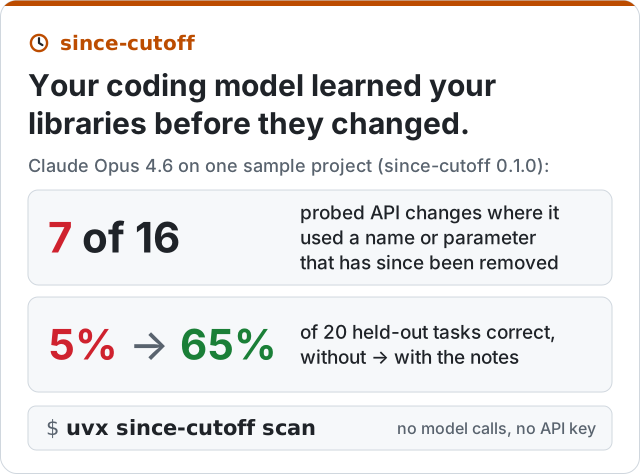
since-cutoff is an open-source command-line tool and MCP server for Python projects written with coding agents. It lists the public API changes in your pinned dependencies since the model’s training cutoff, measures which of them the model gets wrong, and writes short AGENTS.md notes, each checked by a type checker or taken directly from the API diff.
# what changed since your model's cutoff (no model calls, no API key)
uvx since-cutoff scan

# measure the model, write verified notes, add them to AGENTS.md
uvx since-cutoff run --apply
Source and documentation on GitHub · PyPI · How it works, in detail
The rest of this page is the story behind it and the first measurements.
Every coding model has a training cutoff. Your lockfile doesn’t. When a library changes its public API after the cutoff, a model that learned the old version keeps writing the old calls, and nothing in the prompt tells it otherwise.
I wanted a number for that instead of an anecdote: for one real project, which of the exact dependency versions it pins does the model get wrong, and does a short note fix it? since-cutoff is the tool I built to answer it.
The setup
The sample project (examples/agent-app)
is a small agent app with nine dependencies. Six are pinned to current releases (anthropic
1.8.0, openai 3.19.2, huggingface-hub 2.0.0, langchain-core 1.6.5, langgraph 1.2.12 and
pydantic 2.13.5); three are unpinned (fastapi, requests and httpx), so the tool uses their
latest release.
Two models were tested: Claude Haiku 4.5 (training cutoff February 2025) and Claude Opus 4.6 (May 2025). Tasks and notes were written by Claude Opus 4.6.
How it measures
- What changed. For each dependency, take the newest release published on or before the model’s cutoff, and diff its public API against the pinned version, statically (griffe, no code imported). That finds removed and moved objects, removed or newly required parameters, keyword/positional-only changes and new deprecation markers. For this project and Claude Haiku 4.5’s cutoff, 7 of the 9 dependencies changed; the current diff (0.2.0) flags 491 breaking changes and 50 new deprecations, some of them internals.
- Tasks that need the change. For the highest-ranked changes, a task writer produces short, realistic coding tasks that require the changed functionality but never name the changed identifier or its replacement. One task is the probe; two are held out.
- Answers with nothing to look things up in. The model gets the task and the pinned version number, and no tools, no web, no project files.
- Scoring by a type checker, twice. The answer is type-checked with basedpyright against the
version the model could have seen and against the pinned version, each in an isolated
environment with that version’s own dependencies. Only API-knowledge errors count (unknown
names, imports and parameters, missing arguments, arity), never type-strictness complaints.
- stale: valid for the version it knew, invalid for the pinned one
- wrong: invalid, and not explained by the version change
- deprecated: valid, but uses an API marked
@deprecatedin the pinned version
- Fix and verify. For each failure, a one-line note is written for AGENTS.md. A note written by the model is kept only if its example type-checks against the pinned version and every API it recommends appears in that example; otherwise the note is a plain statement of the change taken from the API diff. Then the held-out tasks are answered again, without and with the notes, and compared pair by pair.
No generated code is ever executed.
Results
These runs were made with since-cutoff 0.1.0, on the one project above.
| Claude Haiku 4.5 | Claude Opus 4.6 | |
|---|---|---|
| training cutoff | Feb 2025 | May 2025 |
| API changes probed | 20 | 16 |
| stale / wrong / deprecated / correct | 5 / 1 / 2 / 12 | 7 / 0 / 3 / 6 |
| libraries with stale use | 3 of 5 probed | 2 of 4 probed |
| notes written (type-checker verified) | 8 (7), about 391 tokens | 10 (7), about 437 tokens |
| held-out correct, without -> with notes | 14% -> 57% (14 pairs) | 5% -> 65% (20 pairs) |
| previously-correct APIs after notes | 6/6 still correct | 6/6 still correct |
In this sample the stronger model was not safer. Opus 4.6 has a later cutoff and still wrote
stale code more often: anthropic.HUMAN_PROMPT with client.completions,
hf_hub_download(force_filename=...), resume_download=....
More stale code from the Haiku run, each valid in the version it learned and broken in the pinned one:
client.messages.create(..., temperature=...): removed in anthropic 1.8hf_hub_download(..., resume_download=True),local_dir_use_symlinks=...andproxies=...: removed in huggingface-hub 2.0client.beta.vector_stores: an openai 1.x API that 3.x moved toclient.vector_stores
Does a note fix it?
since-cutoff wrote 8 notes, about 391 tokens, 7 of them verified by the type checker (one fell back to a plain statement from the API diff). For example:
**anthropic 1.8.0**
- `temperature=...` was removed from `messages.create()` in anthropic 1.8.0. Omit the `temperature` parameter entirely; there is no replacement.

**openai 3.19.2**
- `client.beta.vector_stores` is removed in openai 3.19.2. Use `client.vector_stores` instead.
On the held-out tasks for the changes it got wrong, the model was correct on 14% without the notes and 57% with them (14 paired tasks from 7 API changes). The run card also says “4 of 7 changes fixed, 95% CI 25-84%”. That is 0.1.0’s count, which also counted a change as fixed when a held-out answer was already right without the notes, and the interval belongs to that count, not to the two rates. The six APIs it already got right were still right with the notes in its context.
What these numbers do and don’t say
- Small sample. Two models, one project, 16-20 probes each. It is a demonstration of a method, not a benchmark. The confidence interval is wide because the sample is small.
- A sample of changes, not all of them. Probes are ranked (APIs the project’s own code uses first, hard breaks before soft ones); the task writer also skips internals.
- What a type checker can see. Wrong names, parameters, arity and PEP 702 deprecations. Behaviour changes behind an unchanged signature are invisible.
- Held-out tasks are paraphrases of the same change, so the before/after measures whether a note fixes that change, not general ability.
- “The version the model saw” is a date rule (newest release before the cutoff). Models know the months right before their cutoff poorly, so real staleness can begin earlier.
Why I care about this
This grew out of a paper I co-authored for EMNLP 2026 on temporal isolation: using a model’s training cutoff as a natural experiment for what it knows. Library releases are the same experiment with a very practical payoff: the answer is a list of lines to put in AGENTS.md.
Try it
# what changed since your model's cutoff (no model calls)
uvx since-cutoff scan

# measure, write verified notes, apply them to AGENTS.md
uvx since-cutoff run --apply
It works with Claude Code (as a plugin), Anthropic, OpenAI, OpenRouter, DeepSeek, Ollama and
any OpenAI-compatible server.
since-cutoff mcp lets any MCP client (Codex, Cursor, VS Code, Gemini CLI) look up a library’s
changes before writing code, and a
GitHub Action runs the scan on
pull requests. It is Python-only for now; TypeScript is next. Feedback on the method is very
welcome in the issues, and results
from your own projects in
Share your results. If you
would like to contribute code, the
good first issues
are a good place to start.